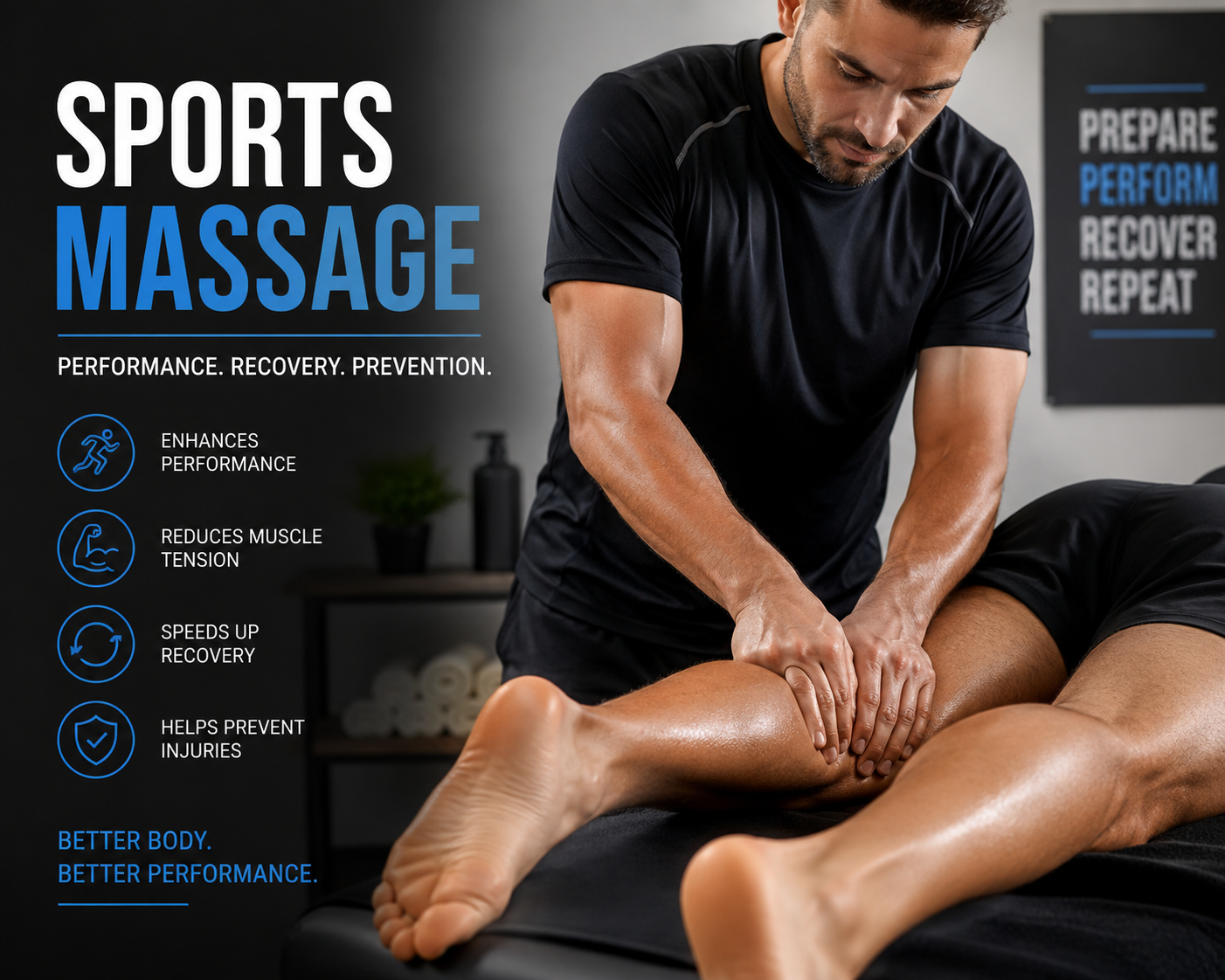
The Benefits of Sports Massage
Dunmore Muscular Therapy · 13 June 2026
The Benefits of Sports Massage | Dunmore Muscular Therapy Suggested meta description: Learn how sports massage can help reduce muscle tension, improve movement, support recovery and prevent recurring aches and pains. Book sports massage in Dunmore, Co. Galway.
The Benefits of Sports Massage
Sports massage is often seen as something only athletes need.
That is not true.
Yes, sports massage can be very useful for runners, footballers, rugby players, gym-goers and golfers. But it can also help people who sit at a desk all day, work physical jobs, feel stiff from daily life or keep getting the same aches and pains.
At Dunmore Muscular Therapy, sports massage is not just about “rubbing sore muscles”. The goal is to assess what is tight, what is overloaded, what is restricted and what may be contributing to pain or poor movement.
What is sports massage?
Sports massage is a hands-on treatment that works on the muscles, tendons, fascia and soft tissues of the body.
It can involve different techniques depending on what the person needs, including:
- Deep tissue massage
- Trigger point work
- Muscle release techniques
- Assisted stretching
- Cupping therapy
- Mobility work
- Rehab advice
- Recovery planning
The treatment should always match the person in front of you. A runner with calf tightness does not need the same session as a desk worker with neck and shoulder tension.
1. Sports massage can reduce muscle tension
One of the main reasons people book a sports massage is because they feel tight, stiff or restricted.
This can happen from training, work, poor posture, stress, repetitive movements or simply not moving enough during the day.
Sports massage can help reduce tension in overloaded areas such as the:
- Neck and shoulders
- Lower back
- Glutes
- Hamstrings
- Calves
- Hip flexors
- Upper back
When muscle tension eases, people often feel lighter, looser and more comfortable in their movement.
2. It can help improve movement
Tight muscles and restricted soft tissue can affect how well you move.
You might notice this when you squat, run, swing a golf club, lift weights, turn your neck, bend forward or reach overhead.
Sports massage can help improve movement by reducing restriction in the muscles and surrounding tissues.
This does not mean one massage magically fixes everything. But when combined with simple mobility work and strengthening exercises, it can make a big difference.
3. It can support recovery after training
Training causes stress on the body.
That is not a bad thing. It is how the body adapts and gets stronger. But if you keep training hard without proper recovery, soreness, stiffness and small niggles can build up.
Sports massage can support recovery by helping the body settle after heavy training, matches, races or gym sessions.
Many athletes use it as part of their routine to keep on top of tight areas before they become bigger problems.
4. It can help with injury prevention
Sports massage cannot guarantee you will never get injured.
No treatment can.
But it can help identify areas that may be overloaded, restricted or under pressure before they become a bigger issue.
For example, a runner may come in with calf tightness, but the real problem may also involve ankle stiffness, glute weakness or poor load management.
A good sports massage session should not only treat the sore area. It should also look at why that area is being overloaded in the first place.
5. It can help reduce pain and discomfort
Many people book in because they are dealing with pain or discomfort from training, work or daily life.
Common issues include:
- Lower back tightness
- Neck and shoulder pain
- Hip tightness
- Sciatica-type symptoms
- Calf tightness
- Hamstring tightness
- Tennis elbow symptoms
- General muscular aches
- Post-training soreness
Sports massage can help calm irritated muscles and reduce discomfort. In some cases, treatment may need to be combined with rehab exercises, lifestyle changes or further assessment.
Pain is rarely just about one tight muscle. That is why assessment matters.
6. It can help desk workers and people with physical jobs
You do not need to play sport to benefit from sports massage.
Desk workers often deal with neck tension, rounded shoulders, tight hips and lower back stiffness.
People in physical jobs may deal with tight forearms, sore backs, hip stiffness, shoulder issues or general fatigue from repetitive work.
Sports massage can be useful for both.
The goal is to reduce tension, improve movement and give the person practical advice they can use outside the treatment room.
7. It can improve body awareness
A good treatment helps you understand your own body better.
You may discover that one side is tighter than the other. You may notice that your hip mobility is limited. You may realise that your shoulder pain is linked to your upper back or neck.
This awareness is valuable.
When you know what your body is doing, it becomes easier to manage training, avoid overload and make better decisions around movement and recovery.
8. It can support better performance
Better performance is not only about training harder.
It is also about moving well, recovering properly and keeping the body in good condition.
Sports massage can support performance by helping reduce restriction, improve comfort and keep the body moving more freely.
For athletes, this can be useful during heavy training blocks, competition periods or return-to-play phases after injury.
For everyday people, better performance might simply mean moving better, working without as much stiffness or getting through the week with less discomfort.
When should you get a sports massage?
You may benefit from sports massage if you:
- Feel stiff or restricted
- Have recurring tightness
- Train regularly
- Sit for long periods
- Work a physical job
- Are returning from injury
- Keep getting the same aches and pains
- Want to improve recovery
- Want help understanding what your body needs
You do not need to wait until something is badly painful before booking in.
Often, the best time to deal with tightness is before it becomes a bigger issue.
How often should you get sports massage?
This depends on your body, training load, job and goals.
Some people book once when they feel tight. Others come in every few weeks as part of their recovery routine.
A general guide:
- For general tightness: every 4 to 6 weeks
- For regular training: every 2 to 4 weeks
- During heavy training blocks: every 1 to 3 weeks
- For injury support: weekly at first, then less often as things improve
The right frequency depends on the person. There is no one-size-fits-all answer.
Sports massage works best with the right advice
The treatment itself is only one part of the process.
To get the best results, sports massage should be paired with clear advice around:
- Mobility
- Strength
- Training load
- Recovery
- Posture
- Daily habits
- Warm-ups
- Rehab exercises
This is where a proper assessment makes a difference.
If the same area keeps tightening up again and again, the question should be:
Why is it happening?
That is the difference between just treating symptoms and helping the body move better long term.
Book a sports massage in Dunmore, Co. Galway
If you are dealing with tightness, stiffness, recurring pain or poor recovery, sports massage may help.
At Dunmore Muscular Therapy, each session is based on what you need. Whether you are an athlete, gym-goer, golfer, runner, desk worker or someone who simply wants to move better, the aim is to help you feel looser, recover better and understand what your body needs.
To book an appointment, contact Dunmore Muscular Therapy today.